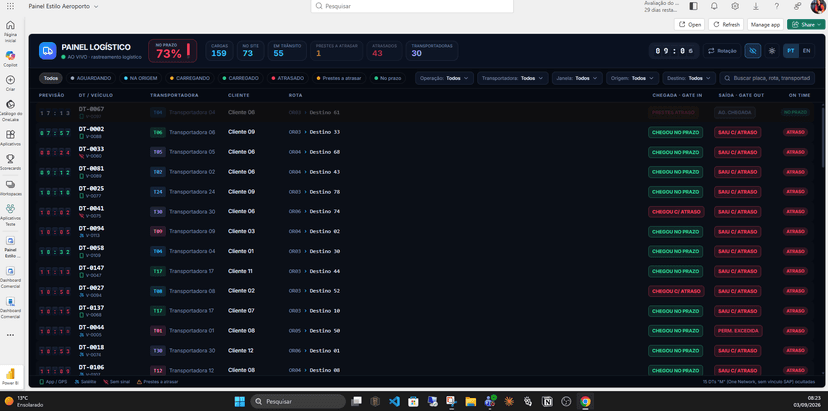
Logística Inteligente
Your shipment is going to be late. The question is: how early will your operation be able to detect it?
In many transportation operations, a delay only becomes visible after it has already happened.

From per-user licensing to shared capacity: the (real case with fictional data) case of a retailer that stopped having to choose between "saving money" and "giving everyone access."
By Tamires Cavani, 08/21/2026
Rede Vitrine (a fictional name for this case) is a retailer with 45 physical stores, one distribution center, and about 700 employees. Like many companies investing in data, it took the natural path: it started with a few Power BI reports, saw the value, and kept expanding.
Three years later, the BI team was celebrating adoption and struggling with the bill.
There were 180 active Power BI Pro licenses, spread across regional managers, store supervisors, finance, operations, and leadership. At a reference cost of $80/user/month, that meant:
And the worst part: only 9 people in the company actually built reports. The other 171 just needed to open a dashboard, look at a number, and make a decision. Even so, they paid the same license as the people building the models.
At the same time, there was a waiting list: more than 220 store employees shift supervisors, operations leads, warehouse staff who the company wanted to give access to the metrics, but couldn't afford to license.
The result was a common paradox: BI had become too successful for the cost model that supported it.
Before any architecture change, Vitrine's data team did a simple mapping, splitting users into two groups:
That second group was the problem and, at the same time, the opportunity. Consumers don't need an individual Pro license if report distribution runs through a properly sized shared capacity.
Vitrine moved from a model based solely on per-user licenses to an architecture combining:
The 9 content producers' licenses were kept they still need a Pro license to publish and manage models. What changed was everything downstream of that.
The numbers
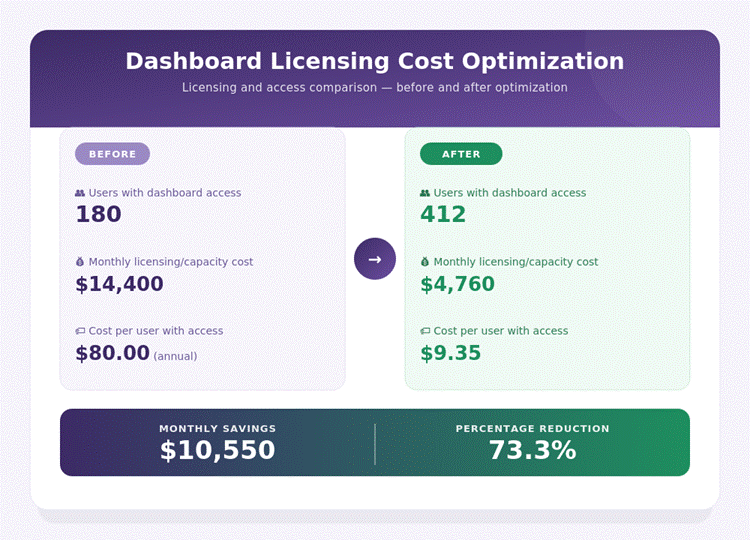
The contracted Fabric capacity (F4 reference tier, resized after the pilot) plus portal costs came in at around $4,760/month even below the initial estimate, because the real usage pattern (many simple, simultaneous queries, few heavy models) required less capacity than the team had projected.
But the number that mattered most internally wasn't the savings. It was this:
In other words: Vitrine didn't trade savings for reach. It got both at the same time because in a capacity-based architecture, adding user number 300 has a marginal cost close to zero, while under the license model that person would cost $80/month like any other.
According to Vitrine's fictional Data Director in the case, "the biggest change wasn't technical, it was cultural: once the cost of giving one more person access stops being a budget decision, BI stops being a scarce resource and becomes part of daily life for any team."
Not everything was immediate. Some lessons came from learning along the way:
No. And that's an important point even in a success case: capacity-based architecture tends to pay off when there are lots of people consuming and few producing content exactly Vitrine's profile, with 9 producers for hundreds of consumers.
Companies with few users, or with a large number of people creating and editing reports (not just consuming), may still be better served by the traditional per-user licensing model.
The right question isn't "is licensing or capacity cheaper." It's: what's the ratio between who creates and who consumes data at my company and how much is it costing today to keep the right people locked out of access?
This is a real case with fictional, illustrative data, built to practically demonstrate how moving from per-user licensing to shared capacity can impact cost and reach at the same time. The numbers reflect a simulation, not a quote actual results depend on SKU, region, usage patterns, Microsoft contract, and the architecture implemented.
In many transportation operations, a delay only becomes visible after it has already happened.
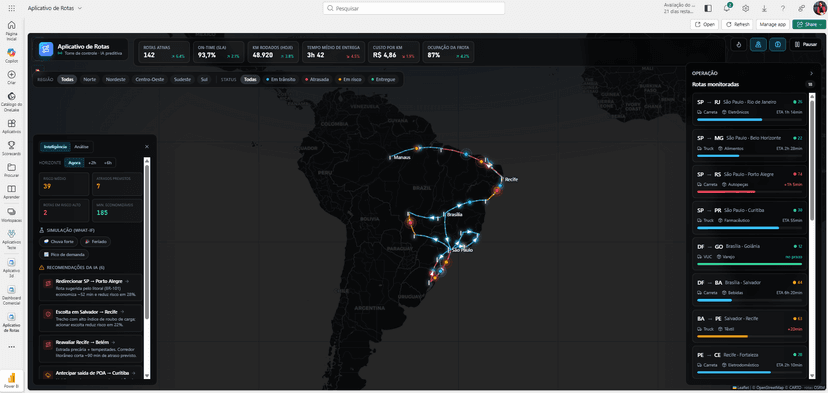
What changes for Power BI and Microsoft Fabric professionals now that the platform is starting to host action — not just analysis.
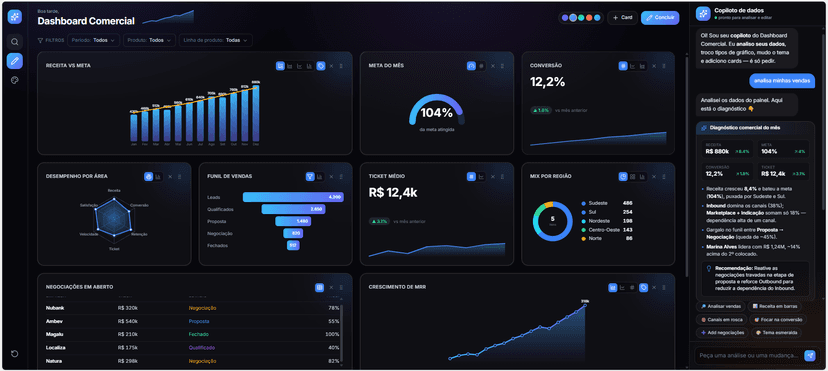
From visualization to action: a new approach to transforming sales data into intelligence, diagnosis, and faster decisions.
Tamires · DriveData
online now