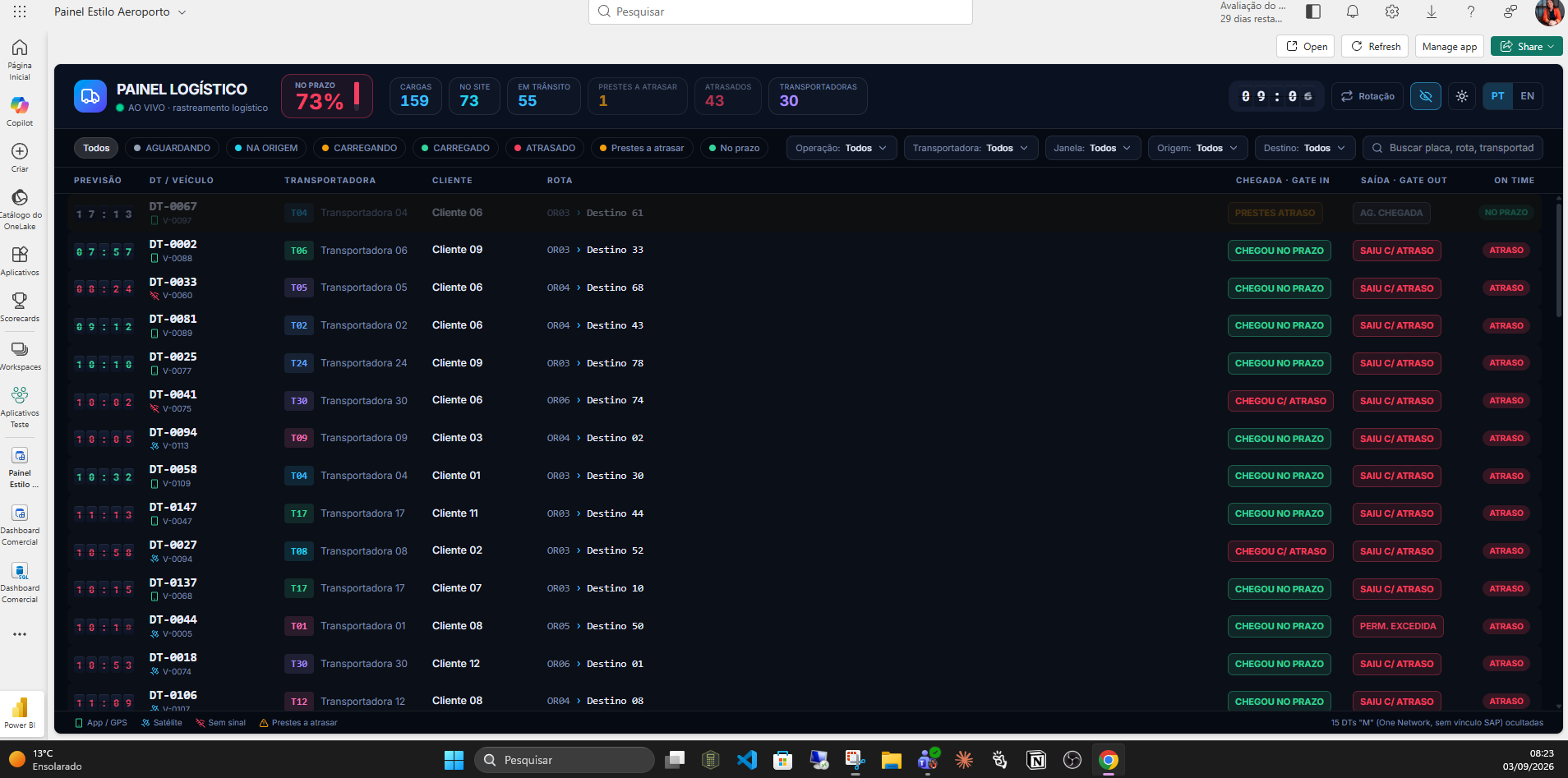

Goodbye Traditional Dashboards: Discover Microsoft Fabric Apps Through an Intelligent Logistics Control Tower
For many years, the primary purpose of Business Intelligence has been to answer a simple question: "What happened?"
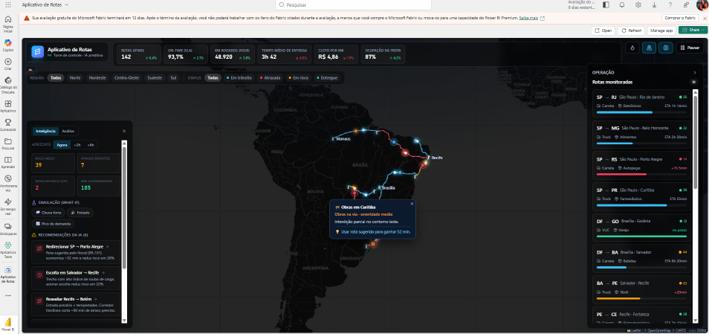
At DriveData, we leveraged this technology to develop an Intelligent Logistics Control Tower, where data, artificial intelligence, and operational processes work together to support real-time decision-making.
What is Microsoft Fabric Apps?
Microsoft Fabric Apps is a full-stack application development platform built into Microsoft Fabric that enables organizations to create enterprise applications directly on top of their business data.
Instead of developing the frontend, backend, APIs, authentication, databases, and infrastructure separately, Fabric Apps brings all these components together in a single development environment.
In practice, this means organizations move beyond delivering dashboards and begin delivering complete operational applications.
While a traditional report answers questions such as:
- How much did we transport?
- What was our SLA?
- Where did delays occur?
An application built with Fabric Apps enables users to:
- Approve route changes
- Register operational incidents
- Trigger operational teams
- Update shipment status
- Execute workflows
- Consume AI-powered recommendations
- Persist operational decisions within the platform
In other words, data stops being just information and becomes an active part of the operational process.
This approach significantly reduces development complexity, accelerates delivery, and keeps the entire solution integrated with Microsoft Fabric's governance, security, and identity model.
From BI to Intelligent Business Applications
Traditionally, a Business Intelligence project ended once the dashboard was published.
With Fabric Apps, the dashboard becomes just one component of a much broader solution.
Organizations can now build applications where users don't simply analyze KPIs—they interact directly with business processes.
This concept is especially valuable for areas such as:
- Logistics
- Supply Chain
- Manufacturing
- Maintenance
- Operations
- Customer Service
- Finance
These are environments where decisions must happen quickly and be driven by reliable data.
The Use Case: Intelligent Logistics Control Tower
To demonstrate the capabilities of Microsoft Fabric Apps, we developed an Intelligent Logistics Control Tower, an operational application designed to monitor and support decision-making across road transportation operations.
Instead of simply displaying trucks on a map, the platform combines operational intelligence, business KPIs, and artificial intelligence to help logistics managers make faster and better decisions.
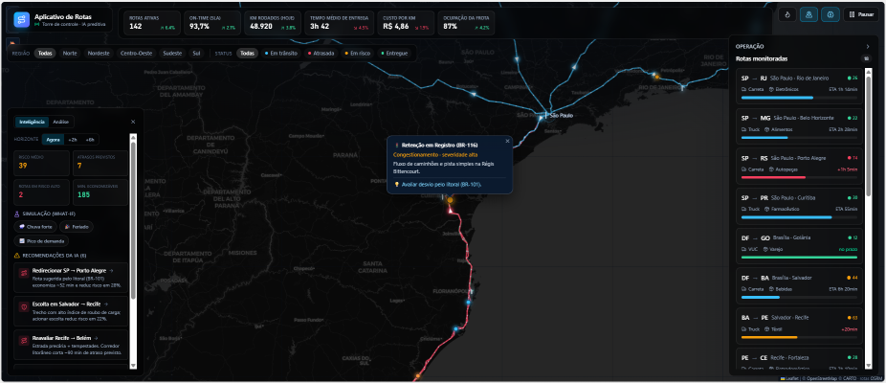
The application brings together in a single interface:
- Nationwide route monitoring
- Real-time vehicle tracking
- Operational KPIs
- Geospatial alerts
- Risk management
- AI-powered recommendations
- Route approval workflows
- Operational history
Everything is connected through a unified operational experience.
Going Far Beyond Vehicle Tracking
The real differentiator of the solution is its ability to transform fragmented operational data into actionable decisions.
The platform correlates multiple data sources, including:
- Traffic accidents
- Road construction
- Weather conditions
- High-risk theft regions
- Estimated travel time
- Cost per kilometer
- Fuel efficiency
- Operational SLA
Whenever a critical event occurs during a shipment, the platform automatically evaluates its operational impact.
Artificial Intelligence then recommends the most appropriate alternative route by considering factors such as travel time, operational risk, transportation cost, and delivery impact.
Finally, the operator can approve the recommended route directly within the application, while maintaining a complete audit trail of every operational decision.
This workflow connects visibility, intelligence, and action, transforming a traditional dashboard into a true operational platform.
Operational KPIs That Drive Decisions
Our Logistics Control Tower consolidates strategic operational metrics, including:
- Total monitored routes
- Operational SLA
- Average lead time
- Freight volume
- Cost per kilometer
- Fleet energy efficiency
- Trip status
- Critical alerts
- At-risk routes
In the prototype, the platform simultaneously monitors more than 140 active transportation routes, displaying real-time service-level, cost, and operational efficiency metrics to support rapid decision-making. These figures are part of the solution demonstration.
Where Does Artificial Intelligence Fit?
Artificial Intelligence is no longer just a chatbot.
It becomes an operational decision-support engine.
Within our application, AI can:
- Identify operational risks before they impact deliveries
- Recommend intelligent route alternatives
- Explain the reasoning behind each recommendation
- Prioritize operational incidents
- Reduce the time between event detection and decision-making
More importantly, AI doesn't simply recommend a route—it provides the operational context behind the recommendation, allowing decision-makers to understand the expected business impact and make more confident decisions.
Expected Business Benefits
Although results vary depending on the maturity of each operation, projects like this typically deliver benefits such as:
- Significant reduction in the time between incident detection and operational response
- Increased delivery predictability
- Improved SLA and OTIF performance
- Lower fuel consumption and fleet idle time
- Reduced exposure to high-risk areas
- Higher productivity within logistics control tower teams
- Faster communication with customers regarding delays and operational changes
- Greater traceability and governance over operational decisions
By bringing together data, artificial intelligence, and operational workflows within a single platform, organizations reduce their dependence on disconnected dashboards, spreadsheets, and legacy systems, enabling faster responses to operational events.
The Future of Data-Driven Applications
Microsoft Fabric Apps represents an important shift in how enterprise solutions are built.
We're no longer talking only about dashboards.
We're talking about intelligent business applications capable of analyzing data, executing processes, recording operational decisions, integrating artificial intelligence, and accelerating real-time operations.
This is a major step toward bringing together Analytics, AI, and Operational Systems within a single platform.
How DriveData Can Help
At DriveData, we build end-to-end solutions using the Microsoft Fabric ecosystem to transform data into operational decisions.
Our expertise goes far beyond dashboard development. We create intelligent platforms that connect data, business processes, and artificial intelligence to solve real business challenges.
Our areas of expertise include:
- Intelligent Logistics Control Towers
- Microsoft Fabric Apps
- Business Intelligence and Power BI
- Data Engineering
- Applied Artificial Intelligence
- Microsoft Power Platform
- Process Automation
- Integrations with SAP, Oracle, TOTVS, Omie, Bling, Conta Azul, and other ERP systems
If your organization is looking to improve operational visibility, reduce logistics costs, and make faster, data-driven decisions, DriveData can help you build a modern, scalable solution ready for the future.
At DriveData, we believe data shouldn't just explain the past—it should power the next decision.